Just a reminder that Sobukan will be closed Thursday 19th April, as I travel to Myuna Bay for the International Ryukyu Karate Jutsu Research Society Gasshuku. We will be open the Tuesdays before and after. If anyone is looking for a little extra training at no extra cost, please head North to Denshinkan on Monday this week or next.
No advanced martial artist will undermine the importance of the elbows. In addition to being a very solid striking weapon, the control of the elbows in offensive and defensive technique is paramount.
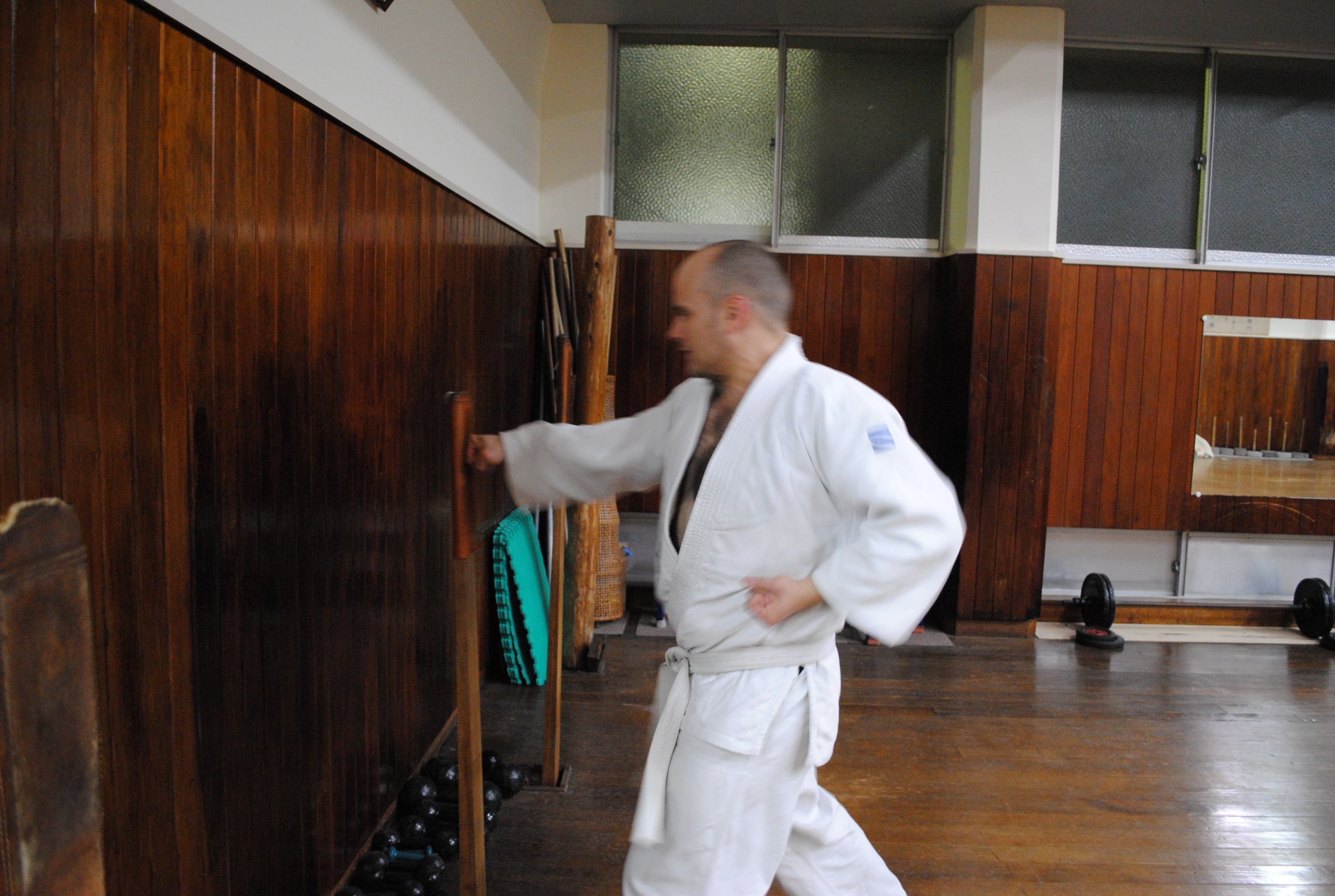
Let’s consider the simple straight punch. Beginners will often concentrate on the fist, aiming to project it at the target with maximum speed and power. However this approach will often lead to the elbow separating from the hip and wasting the power generated in the legs, hips and waist. It will also affect the trajectory of the punch. As the elbow separates from the hip, the punch curves and the point of impact shifts to an outer portion of the fist, which is not in line with the forearm bones. This endangers the smaller fingers and wrist.
A much more efficient and effective method of delivering power into a straight punch is to focus on projecting the elbow towards the target. The fist then penetrates the target in a straight line with strong structural integrity, as the forearm bones will be in natural alignment with the fist. Transfer your bodyweight at the same angle as the punch to maximise force and minimise the likelihood of damage to the fist.
Ideal ways to practice this motion is to concentrate on pushing from the elbows when doing push-ups, and to train on a makiwara (punching post). My own makiwara is an unforgiving jacaranda tree wrapped in rope, which is quick to remind me when my technique gets lazy.
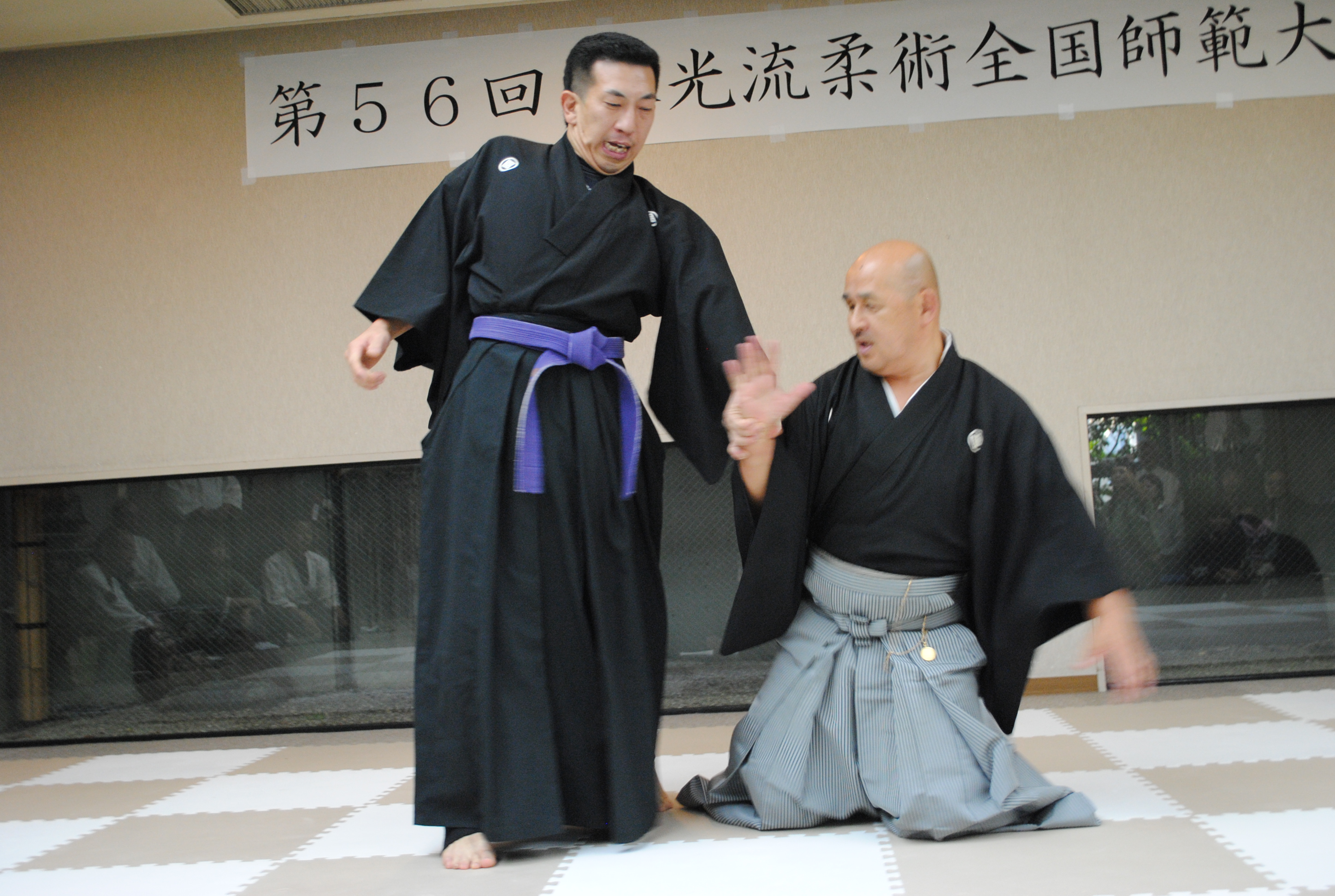
Arguably more important than the lesson above, is how to control the opponent’s elbow in the heat of battle. If an opponent is off balance, they cannot launch an effective attack or defence. If you control the opponent’s elbow, it is easy to disrupt their balance – especially if they are using muscular strength. This is why judo practitioners grip at the elbow.
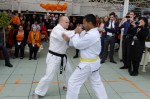
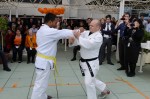
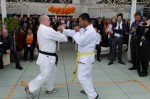
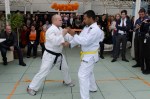
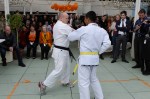
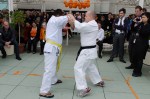
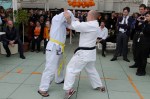
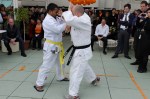
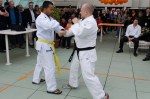
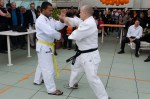
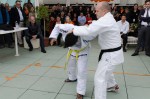
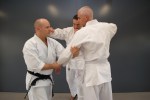
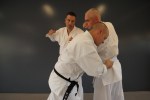
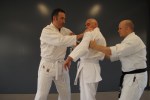
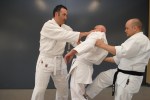
Koryu Uchinadi Kenpo Jutsu’s (Classical Okinawan Karate) Tegumi drills are ideal ways to practice elbow control. Parry an opponent’s hand attack and enter with your whole body, using the forearm to apply weight to their upper arm, just above the elbow. Keep your forearm vertical, as this gives the greatest range of motion and control of the opponent. Once the elbow is controlled, you only have to walk toward the opponent maintaining elbow control to affect their balance and pre-emptively defend against hand strikes or kicks. For further demonstration of this concept, please come directly to Sobukan Martial Arts in Mitcham, SA!
Wing Chun, one of the more scientific of martial arts, offers the following maxims, amongst others:
– During sticky hand practice, the hand which has entered beyond the elbow will win nine times out of ten.
– The elbow must be strong. Then you can take on any attack.
The importance of relaxed elbows was impressed upon me at the Hakkoryu Jujutsu So-Honbu dojo in Saitama, Japan. When any muscular power is used, the elbows tighten and connect the movement of the hands to the balance of your entire body. A small pull or push of your arms will affect your entire body. If your elbows are completely relaxed, an opponent can yank and push your arms and it will have little effect on the rest of your body. Visualise a body made of wood versus one made of rope to better comprehend this principle.
Some of the most common errors in Jujutsu are also due to employing strength in the elbow joints. Doing so changes the bio-mechanics of the arm, raising the shoulder affecting the angle of the technique and neutralising its effectiveness. Too often, the martial artist will then try to force the technique to work, further reducing its effectiveness and leaving them vulnerable to counter-attack.
Elbows need to be taken care of though. Apart from their likely exposure to arm-bars and arm-locks, I have recently been suffering from one tennis elbow and one golf elbow. They seem to be rather susceptible to over-use injury. Take care of them!
It is fair to say that the importance of proper understanding of the elbow joint is a universal principle that transcends style. If you are a beginning martial artist, please remember this lesson as you progress. If you are a black belt looking for the next level of development, it may lie in the elbows. Relax your elbows, and fire punches from them. Neutralise attacks at the opponent’s elbow and disrupt their balance at the same point. This will buy you time to consider your next move. And don’t forget the elbow is one of the four hardest points of the body. Striking will this rock hard point is sure to do plenty of damage to an attacker, while protecting our vulnerable hands. Elbows, what would we do without them?
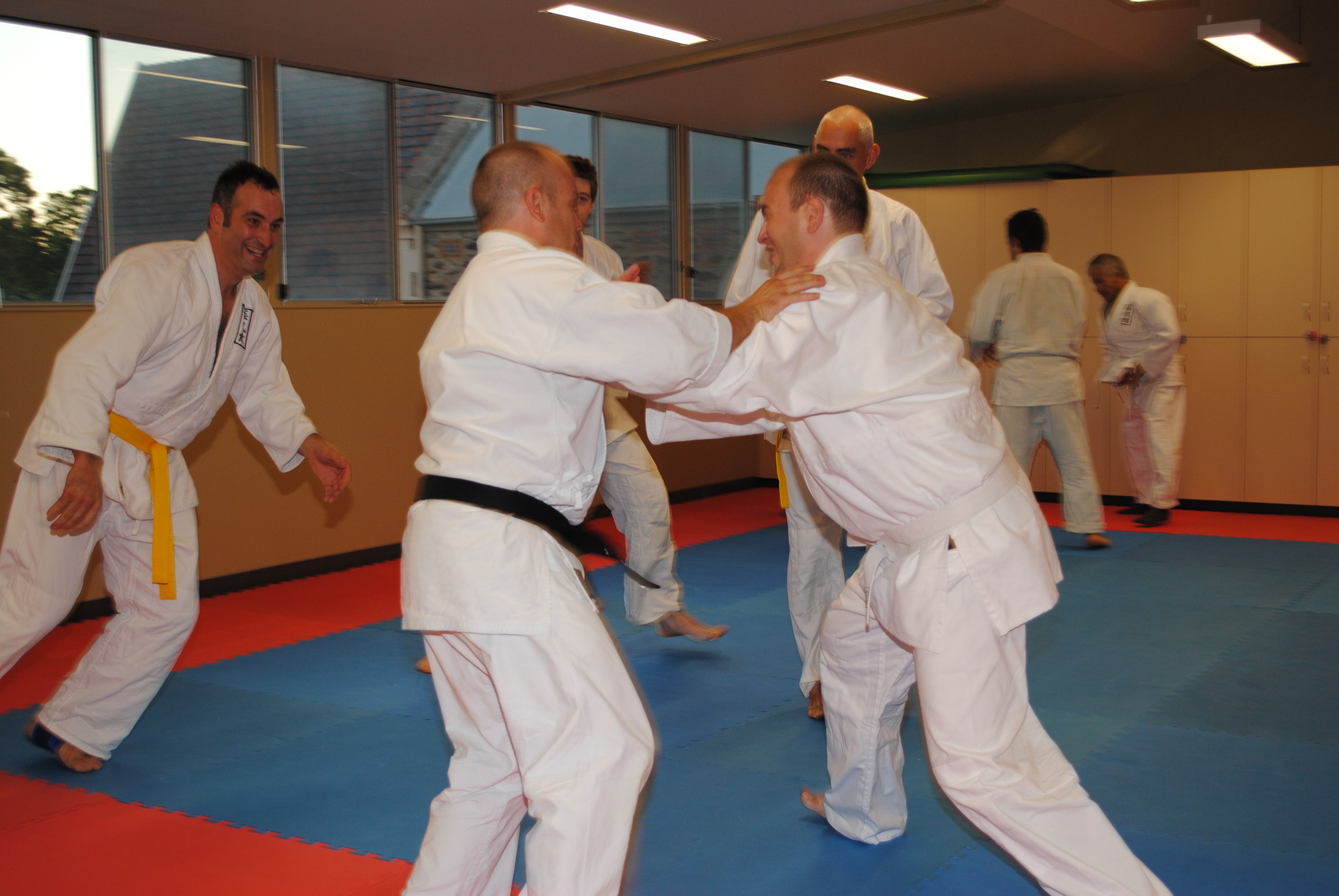
We had some delicious Hakkoryu jujutsu moves for an entree, quite advanced for a starter. We then sampled a buffet of 12 tegumi drills, before feasting on a course of breakfalls and judo combinations. Mains consisted of a bold serving of shootboxing drills topped off with light sparring. Finally for desert, we enjoyed a range of ground escapes and some sweet free rolling. Well, I’m full! How was your night?
Please take note that Sobukan will be closed on Thursday 19th April.
To be a good instructor, you must first be a good student. Learning should never stop. For those reasons, I will be going to a Gasshuku, a martial arts training camp, in NSW. The Gasshuku is run annually by the world’s foremost karate historian and kata expert, Hanshi Patrick McCarthy of the International Ryukyu Karate Jutsu Research Society. Although I have wanted to go for the past few years, ths year is my first time I have been able to attend.
Hopefully I will come back with plenty more quality information and a greater, deeper understanding of karate / Koryu Uchinadi Kenpo Jutsu. I apologise for the inconvenience, but look forward to sharing my new found knowledge with you all!
A focus of Sobukan Martial Arts is for students to achieve functional spontaneity in self-defence via fun, safe and realistic training methods. Functional spontaneity is a term borrowed from Hanshi Patrick McCarthy of the IRKRS. Functional spontaneity means to be able to adapt quickly and effectively within the context of violent conflict. I believe one reason why Sobukan has proved popular with experienced martial artists is because they can see the functionality of our training methods when compared with some of their previous martial art training.
In order to achieve functional spontaneity, we use the 3R approach:
Repetitious Replication of Reality.
Repetitious replication of reality means to regularly practice defending against common attack scenarios. However, to replicate reality too closely too soon is to risk injury. Injuries are a direct barrier to the Sobukan motto of ‘Healthier, Happier, Safer’, and therefore great care is taken to minimise the likelihood of injury, while providing functional and effective training.
How do we do this? Glad you asked! To summarise, we train for the following:
Early identification of an attack;
Automatic initial response aided by physical and mental training of contingency plans;
Muscle memory;
Use of force matrix aided by scenario-based training;
Strength and balance, by eliminating our weakness; and
Efficient and effective principle-based responses.
Some of the main training methods for doing so are:
Tegumi (and other related Koryu Uchinadi Kenpo Jutsu drills)
Uchikomi
Randori
Kumite (safe MMA sparring)
Reflex training
Slap-grappling
Scenario training
Visualisation training
Again borrowing from Hanshi McCarthy, each class starts by practicing defences against habitual acts of physical violence (HAPVs). We train for early identification of attacks, and muscle memory in defensive applications. Simple, set, continuous defensive exercises such as tegumi and uchikomi are a core method for achieving this. The live nature and intensity of tegumi, randori, newaza (ground grappling) and kumite keeps students on their toes and teach students the principles of balance, controlling the opponent’s elbow and coordination of the entire body. These drills are flexible enough to adapt to individual needs or desired outcomes.
So, what do I mean by desired outcomes? Isn’t the objective in self-defence always to win?
This question will be answered in another blog in the near future…
I cant believe a year has passed since the Japan disaster. It was an unbelievable experience. Constant earthquakes, rapidly rising raditation, no sleep for days on end, thousands of people disappearing before your eyes, no food or water in shops (even in Tokyo), and a lack of phone communication and transport. Yet the Japanese people are incredibly stoic and even in the immediate aftermath they continued their daily routines with hardly a hint of the complex cocktails of emotions we all felt. Lets pause to remember the 20,000 lost, and millions who lost family, friends, pets, jobs, homes and lives as they knew them. And let us not forget the thousands who will be sick in the future from radiation exposure. I miss you Japan.
There are many activities on today to mark the one year anniversary:·
It would be appreciate if all available Sobukan students can come to Himeji gardens at noon for a yagai geiko training session. Please wear your gi.
· The JETAA are supporting the “Big Bento Lunch” initiative to raise money UNICEF to fund their ongoing relief effort in the region. Visit the website to see how you can join in. http://www.bigbentolunch.com.au/
· You can send a message of support to the people of Tohoku as part of the “Million Hearts for Japan” project. Post on the wall and your message will be taken to Tohoku and displayed on special screens that have been set up. https://www.facebook.com/Ganbatte365?sk=wall
· JAFA is looking for volunteers to go to some of the most harshly affected areas to help with ongoing clean-up and relief efforts. The number of volunteers in the region has dropped off dramatically and more help is needed. If you are interested in volunteering, click on the link below. http://www.jafa.asn.au/index.php/component/content/article/141-jafa-volunteers
· Finally, all of the international networks will run anniversary coverage throughout the day. There will also be a number of other documentaries running on Foxtel’s Discovery Channel on Sunday: – Megaquake : the hour that shook Japan – Emergency in Fukushima – Beyond the tsunami with Ken Watanabe – Rebuilding Japan
Furthermore, a documentary entitled “Children of the Tsunami” will be screened on Sunday at 8:30pm on ABC2. http://www.abc.net.au/tv/programs/sundaybest.htm
As the title suggests, after a month break, Wednesday lunchtime MMA classes will resume this week, Wednesday 7th March. These classes are strictly for adult Sobukan members, and unfortunately are not available for trial lessons or spectators. I look forward to rolling with you on Wednesday! Please contact me at chris@sobukan.com.au for details.
Congratulations to the first students to attempt a formal Sobukan grading (Shane Webster graded to yellow belt on the basis of 6 months of private lessons, not a formal grading).
Sobukan grading
The grading was conducted at the Mitcham dojo on Saturday afternoon. Three junior and three senior students tested for promotion, and all succeeded! Congratulations to juniors Mika and Marley Tarver, Connor Seifert and adults Julie Tynan, Dan Sinclair and Marcel (Dizzy) Gillespie!!
Tegumi drills – Dan and Dizzy
The theme for yellow belt is ‘safety and self defence’. The gradings lasted for a total of about three hours and tested knowledge and skills including a working knowledge of the 4 stages of self defence; dojo ettiquette; Koryu Uchinadi Kenpo Jutsu’s 12 tegumi (punch defence) drills; tsuki (uke) waza (an application drill for 6 blocks); Judo ukemi waza (breakfalls) and the first 8 throws of the Judo Gokyo.
Juniors
Juniors were tested on a slightly modified version of the above, but also tested on basic kicks, punches, blocks, a self defence drill, kumite, Judo randori and newaza (ground grappling). Adults were thrown in the deep end with a self defence test involving two attackers armed with a knife and gun.
Grading candidates were given a score out of 10 for the above skills, with 10 being awarded when the demonstrated skill level met my (high) expectations for yellow belt. 80% was the pass mark. This allows students to personalise the curriculum to their own physical, occupational or personal needs, while still encouraging them to work hard on minimising their weaknesses. Therefore, candidates can choose not to demonstrate up to 1/5 of the grading requirements (in particular for medical conditions), as long as the other 4/5 is perfectly in line with my expectations. Alternatively, this gives students the peace of mind that they can make a few mistakes and still be eligible to grade if they know the curriculum well.
Junior judo
Particular credit goes to Marcel Gillespie, Mika Tarver and Connor Seifert who all scored close to perfect scores! Well done all!!
We have at least another half a dozen students close to yellow belt, and Shane Webster is not far from orange belt. One student commented today that he cannot believe that he has only been training for 3 months, as he has learned so much!
I am very proud of Sobukan Martial Arts, and Sobukan student’s achievements over the past 3-4 months! We have a big future to enjoy!!
明けましておめでとうございます!(Happy New Year – pronounced Akemashite omedeto gozaimasu).
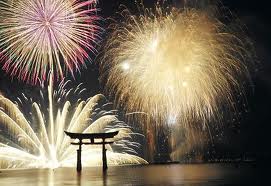
Fireworks in Japan
Sobukan is officially into its second year, with first training (初稽古) being held at Glenelg beach tomorrow morning at 10am! If free, please come along for some fun, training, and to share your new year’s resolutions. This will not be a formal class and adults, children and family are all welcome. If you dont want to train in the heat, please simply enjoy the water.
In Japan, the first training of the year is called Kagami Biraki (opening the mirror) and is a good time for reflection. Traditional Japanese martial art dojo often celebrate Kagami Biraki. The 300 year old tradition is an opportunity to renew your dedication to your training. It is often held on 11 January, but who can wait that long?!
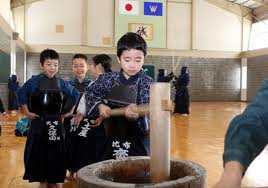
Kagami Biraki is often celebrated by opening a cask of sake and eating mochi, but consuming alcohol in the hot morning sun is not a great idea, and I am assuming some will still be getting over their new year’s celebrations, so let’s have fun by beating each other up instead!
New Years is the most celebrated event on the Japanese calendar and there are plenty of important customs still observed to this day. We can discuss these further on Monday, as we have Umehara-san, Sobukan’s own expert on Japanese history and culture, attending.
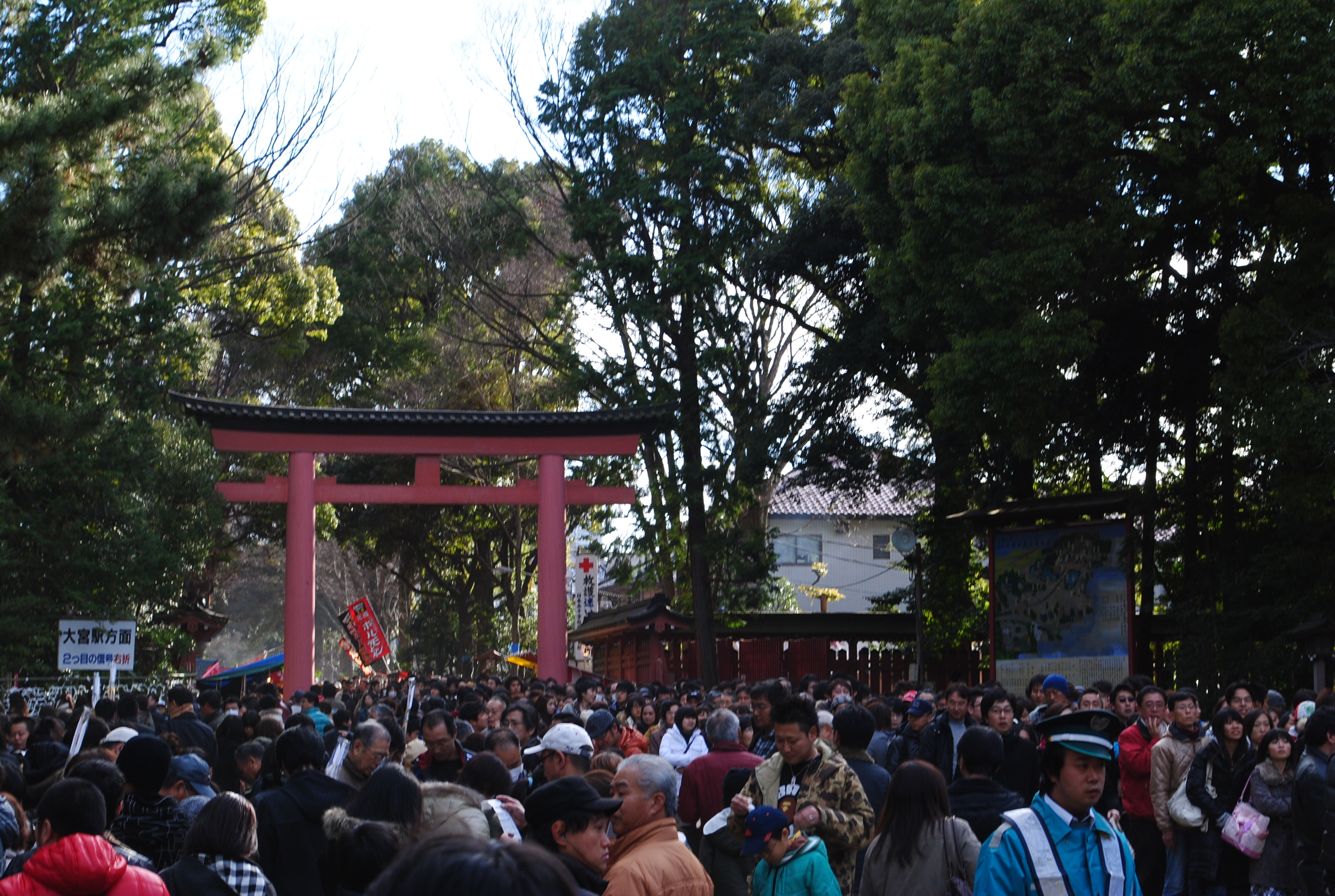
Hikawa jinja at New Years 2011
Some examples are:
lAttending and praying at a shrine (hatsumode)
l Buying a ceremonial arrow, and returning the one you bought the previous year
lBuying omamori ‘luck charms’
lEating toshi-koshi soba noodles at midnight, then special ozoni, osechi and mochi foods in the following days
l Temples ring their bells 108 times to rid the 108 sins
lSend nengajo postcards
lGive otoshidama money pouches to children
lWrite poetry or kanji characters to symbolize a goal or theme for the year (kakizome)
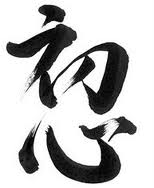
For 2012, I have selected the characters 初心for my kakizome, which are pronounced shoshin and symbolise a return to the beginning.
初心
According to Wikipedia, Shoshin (初心) is a concept in Zen Buddhism meaning “beginner’s mind“. It refers to having an attitude of openness, eagerness, and lack of preconceptions when studying a subject, even when studying at an advanced level, just as a beginner in that subject would. The term is especially used in the study of Zen Buddhism and Japanese martial arts.
In the beginner’s mind there are many possibilities, in the expert’s mind there are few.
Sobukan has the following goals for 2012:
Help students become healthier, happier and safer;
Establish programs for students in wheelchairs and with visual impairments;
Initiate more classes to suit student’s needs;
Increase student membership to a level to support dedicated premises








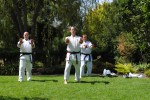
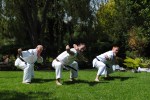
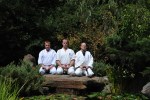
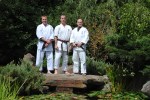




 Sobukan Dojo